
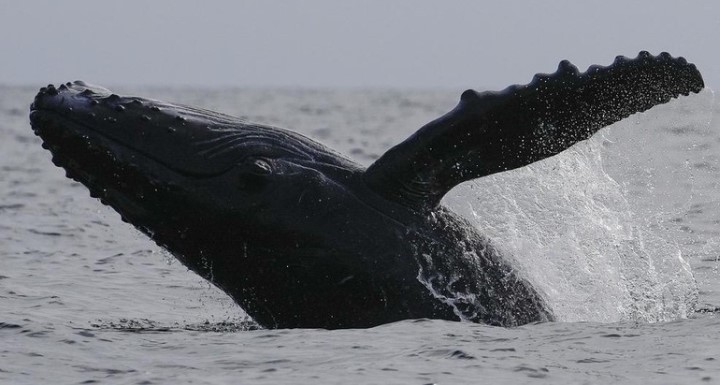
An unusual sight has been drawing attention off the coast of Rio de Janeiro, Brazil. Humpback whales, a species that once came close to extinction, are now returning in growing numbers and becoming a new attraction for tourists.
The whales can be spotted on boat tours departing from Rio de Janeiro and heading toward the waters around the Cagarras Islands, located about 5 kilometers from Ipanema Beach.
As the boat moves farther from the coastline, passengers carefully scan the ocean in search of marine life. Dolphins may appear first, but the real highlight comes when large bursts of water suddenly rise from the sea.
On one recent trip, two humpback whales surfaced near the boat. The enormous marine mammals briefly came to the surface to breathe before disappearing beneath the waves again.
For visitors hoping to see whales in the wild, the encounter can be an unforgettable experience.
From Near Extinction to Nearly 30,000 Whales
The return of humpback whales to Rio is closely linked to the remarkable recovery of the species in Brazilian waters. Every year, humpback whales migrate along Brazil’s coast between June and November. They travel from waters around South Georgia and the South Sandwich Islands toward the warmer waters of Brazil, where they breed.
However, Brazil’s humpback whale population once faced a serious threat. Large-scale commercial whaling caused whale numbers to decline dramatically. Historical records show that whale hunting took place in Brazil as far back as the 18th century. One example can be seen in artwork by Brazilian artist Leandro Joaquim depicting whale hunting in Guanabara Bay.
The situation began to change after the global ban on commercial whaling came into effect in 1986. Thiago Ferrari, director of Amigos da Jubarte (Friends of the Humpback Whale), said the Brazilian population has since experienced a dramatic recovery.
“By the end of the 1980s, fewer than 1,000 individuals had been recorded. Today, there are nearly 30,000,” Ferrari said, according to The Guardian.
Humpback Whales Are Also Returning to Guanabara Bay
The whales are not only appearing along their traditional migration routes. This year, a humpback whale has been repeatedly spotted inside Guanabara Bay, a heavily urbanized area of Rio de Janeiro.
At least 18 sightings have been recorded, surprising researchers because the bay is surrounded by one of Brazil’s largest cities. Marine biologist Liliane Lodi, from the Ilhas do Rio research project, said whale sightings around Rio have increased steadily since they were first documented in 2014.
Even more interestingly, researchers have begun observing behaviors commonly associated with whale breeding areas. These include sightings of calves, competition between male whales, and the distinctive songs produced by humpback whales.
Lodi believes the whale repeatedly seen inside Guanabara Bay may be the same individual. The young whale has reportedly remained in the bay since mid-June. Its presence has become a spectacle for residents and people working around the waterfront, particularly during the morning.
Whale Watching Becomes a New Tourism Opportunity
The growing number of humpback whales has also created a new opportunity for wildlife tourism in Rio de Janeiro. Several tour operators have started offering whale-watching trips for visitors who want to see the animals in their natural habitat.
One of them is ROC Sail, which takes tourists out to sea aboard the Boaventura II. Theo Andrade, one of the company’s co-founders, said seeing a humpback whale in the wild offers an experience that is difficult to compare with other tourist attractions.
For visitors, seeing a marine mammal weighing several tons swimming and surfacing nearby can be a once-in-a-lifetime experience. Luciane dos Santos, 53, was one of the tourists who joined a whale-watching trip. She was fortunate enough to see six humpback whales swimming and performing different movements at the surface.
“I was extremely satisfied. It was truly a gift from nature,” she said.
Tourists Also Contribute to Whale Research
Whale-watching tours are not solely focused on tourism. During ROC Sail trips, environmental science student Mariana Bueno also joins the boat. Her role goes beyond assisting passengers.
She records the number of whales observed, their behavior, and how they respond when boats are nearby. The data is then provided to Amigos da Jubarte for scientific research. The organization also provides training for whale-watching operators.
Around 20 cetacean-watching agencies in Rio have received certification through the program. One of the key rules is that boats must maintain a distance of at least 100 meters from whales.
Boats are also prohibited from remaining around the same whale for an extended period.
Growing Number of Boats Raises Concerns
Despite the positive news surrounding the recovery of humpback whales, researchers remain concerned about the growing popularity of whale-watching tourism. As whale populations increase, more tourists are interested in seeing them. This has also resulted in more boats gathering around whale migration routes.
According to Lodi, increased boat activity could lead to more frequent interactions between humans and whales. The animals already face several other threats in Brazilian waters, including fishing activity, large vessels, chemical pollution, and underwater noise pollution.
Brazil has regulations designed to protect whales, including a ban on tourists swimming with the animals. However, Lodi believes stronger enforcement and monitoring are still needed. Maintaining a safe distance will only be effective if all whale-watching operators follow the rules consistently.
A New Challenge for Rio’s Returning Whales
The return of humpback whales to the waters around Rio de Janeiro is an encouraging sign of successful conservation efforts. Once pushed close to extinction by commercial whaling, the species has made a remarkable comeback and is now attracting tourists from around the world.
But the recovery also brings a new challenge.
As whale-watching tourism grows, authorities, researchers, conservation groups, and tour operators must find a balance between allowing people to experience these magnificent animals and protecting them from excessive human activity.
The humpback whales have returned to Rio. The next challenge is making sure they can stay there without becoming disturbed by the very tourism their comeback has created.