
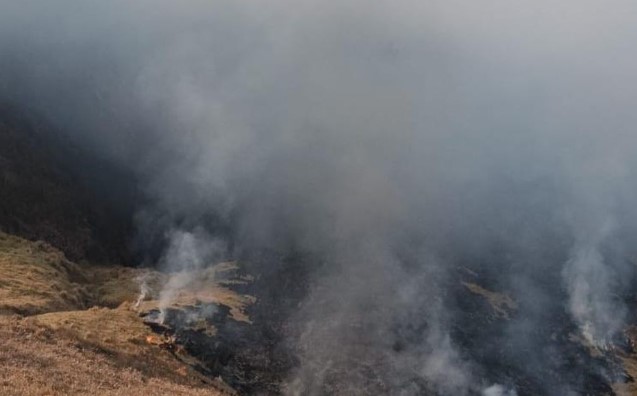
Wildfires burning across the Bromo Tengger Semeru National Park (TNBTS) continue to spread. As of Saturday morning, August 8, 2026, the fire has scorched approximately 176 hectares , a sharp jump from the 127 hectares reported just the day before , with flames now roughly 2 kilometers from the popular Puncak B29 viewpoint in Argosari Village, Senduro District, Lumajang Regency.
Firefighters Race to Contain the Blaze
Joint emergency teams have set up firebreaks to prevent the fire from spreading further and encroaching on the tourist area. Firefighting efforts are being carried out both on the ground and, increasingly, from the air.
Head of the Lumajang Regency Disaster Management Agency (BPBD), Isnugroho, said personnel from BPBD, the Lumajang Police, and the Indonesian military (TNI) have been deployed to help extinguish the fire and anticipate its movement.
“Officers are currently being deployed to assist firefighting efforts in the TNBTS area,” Isnugroho told detikJatim.
Field monitoring shows the fire front sitting more than 2 kilometers from Puncak B29. Crews are working to hold that line and keep the flames from moving any closer to the tourist area in Argosari Village.
Ground crews are using a traditional method called gebyok , beating back flames with tree branches to cut off the fire’s path , along with jet shooters, fire trucks, and water tanker trucks to reach areas accessible by road.
What’s Driving the Spread
According to preliminary data from the TNBTS management authority (Balai Besar TNBTS), the burned area had reached 127 hectares by Friday afternoon before climbing further to 176 hectares by Saturday morning , a rapid escalation that has alarmed officials. East Java Governor Khofifah Indar Parawansa, who visited the site to review firefighting operations, noted just how fast the fire has grown: from an initial 7.9 hectares, it expanded to 44, then 51, and now stands at 176 hectares.
New hotspots have also been reported in Sariwani Village, Sukapura District, Probolinggo Regency, with flames continuing to push northward toward the broader Bromo area , and, separately, toward the Lumajang Regency border, where crews have been building firebreaks to keep the fire from crossing over.
Strong winds, high temperatures, and dried-out vegetation have allowed the fire to spread rapidly through savanna grassland and shrubland.
As for the cause, officials have not yet confirmed the exact source, though the head of Balai Besar TNBTS, Rudijanta Tjahja Nugraha, said human activity , rather than natural causes , is the leading suspicion. Some reports point to negligence involving a campfire left behind by visitors trying to stay warm in the area’s cold mountain air, though this has not been officially confirmed.
Air Support Joins the Fight
The joint task force handling the fire includes Balai Besar TNBTS, East Java’s provincial BPBD, Probolinggo’s BPBD, the TNI, the national police, Manggala Agni (the Ministry of Environment and Forestry’s firefighting corps), and volunteers.
Firefighting has now been reinforced from the air. Two BNPB helicopters, dispatched from Pangkalan Bun in Central Kalimantan, have arrived and begun water bombing operations at hotspots too difficult for ground crews to reach , each capable of carrying around 1,000 liters of water per flight. A third helicopter was scheduled to arrive on Saturday, August 8, to further speed up containment efforts.
In these operations, helicopters draw water from Lake Ranupani before flying to the fire zones. Aerial firefighting has faced some weather-related setbacks, though, particularly strong winds around the Ranupani area.
Beyond the helicopters, East Java’s provincial BPBD has also deployed a water-spray drone with a 150-liter capacity to help reach hotspots that remain difficult to access.
Tourist Areas Remain Closed
Rudijanta said several tourist areas, including Watangan Valley and the Savanna Plains, remain temporarily closed. The closures are meant to support firefighting operations while keeping visitors safe.
“The closures remain in place because these routes serve as the main access for firefighting mobilization and equipment delivery. We’re also prioritizing visitor safety in case the fire continues to spread,” Rudijanta said.
Access to Bromo has been narrowed to just two entrances , Cemoro Lawang in Probolinggo and Wonokitri in Pasuruan , with visitors currently limited to the Sea of Sand area. The Jemplang and Coban Trisula entrances in Malang Regency, along with the Senduro route in Lumajang, remain closed until further notice.
Crews are now concentrating on hotspots that haven’t yet been extinguished, particularly those along cliffs and steep terrain that are difficult to reach by ground. Officials say the next phase of water bombing operations will prioritize these hard-to-reach fire points, with hopes that combining ground and air firefighting can bring the blaze under control before it spreads further or reaches the Puncak B29 tourist area.